
Calls to Action Without Risk Mitigation Are Reckless

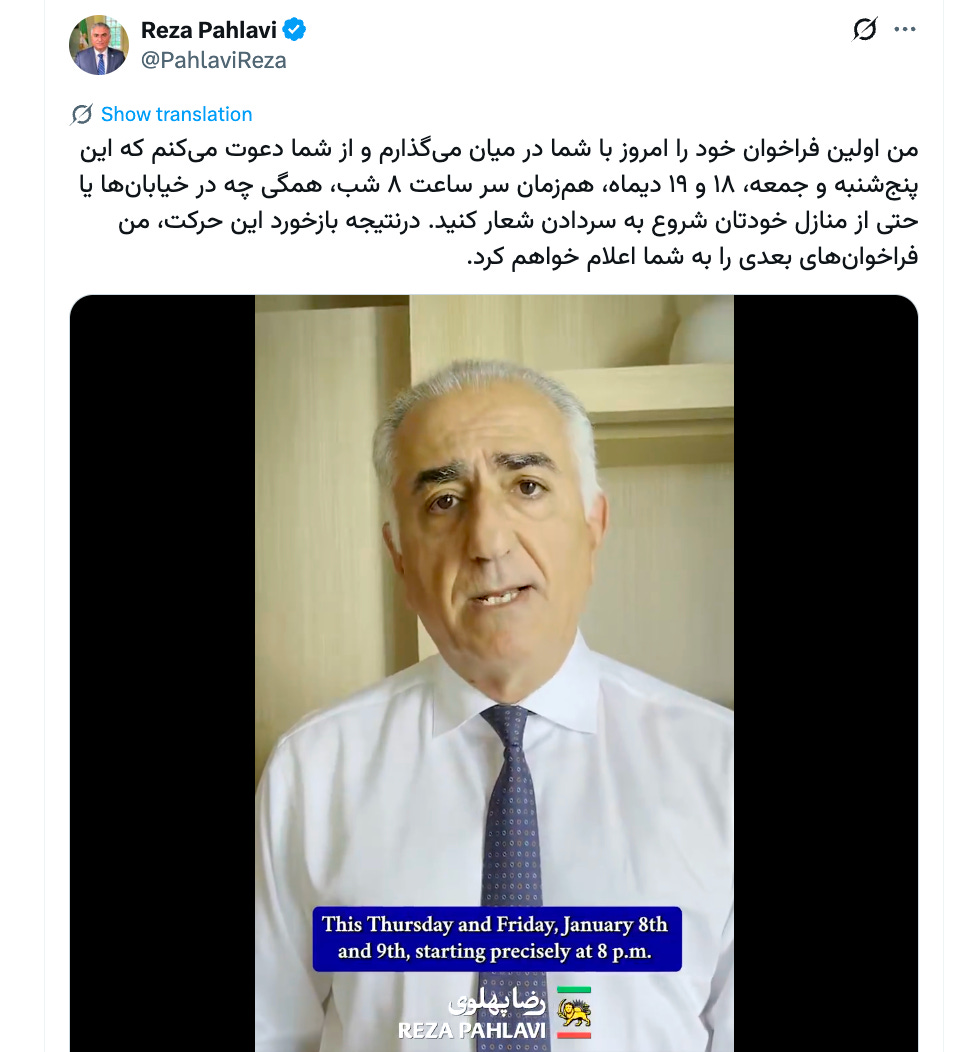
Reza Pahlavi has made many claims and issued many calls to action that went nowhere. But the one time he explicitly urged people into the streets, he made a major, avoidable mistake.
On Jan. 6, he called for protests at a precise hour, “starting precisely at 8 p.m.” on Jan. 8 and 9: “Today, I am sharing my first call to action with you. This Thursday and Friday, January 8 and 9, starting precisely at 8 p.m., wherever you are, whether in the streets or even from your own homes, I call on you to begin chanting exactly at this time. Based on your response, I will announce the next calls to action.”
Setting an exact time is not strategy. It is a schedule, and under a brutal regime, schedules get people slaughtered. We now know the scale of the mass killing on Jan. 8 and 9. The massacre was carried out by the regime, by Khamenei’s forces, and the blood is on their hands, full stop. But that does not excuse reckless leadership decisions. They should be scrutinized too.
Many knew what the IRGC and Basij do when they “step in.” This system has a long record of crushing protests with live fire and mass arrests.
Early warning
On Jan.7, a veteran broadcaster warned people not to listen and not to fall into this trap. Kamran Atabaki posted this video on Instagram. He argued that announcing an exact time, like “8 p.m., fill the streets” (for Jan. 8 and 9), puts people directly in the regime’s sights and endangers lives. He asked, “Is this man(Pahlavi) mad, or does he want to get everybody killed?”
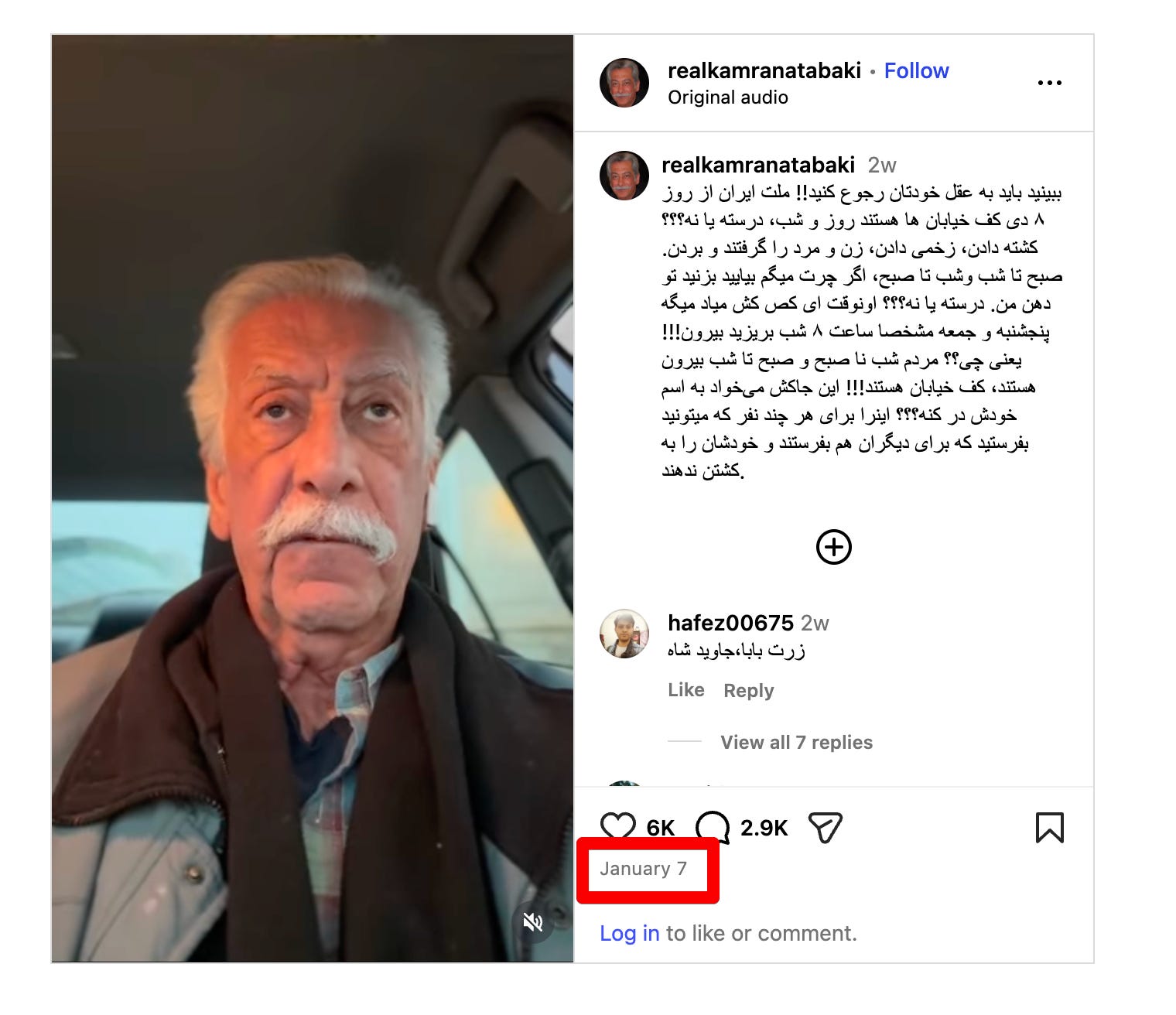
His message was blunt: don’t go out on the exact date and at the exact time. “They’ll kill you all,” he warned.
So what could have been done differently?
When a regime treats the streets like a hunting ground, announcing an exact date and hour is like handing it a timetable. It allows security forces to pre-position units, set ambush points, cut internet and transit at the right moment, isolate neighborhoods, and strike when people are most exposed and least able to adapt. You are making repression easier.
This is not an argument for “never protest.” It is an argument for realism. In high-repression environments, rigid, centralized calls tend to be high-risk and low-return unless there is serious mitigation in place. Most loud political figures offer slogans, not protection.
A smarter approach under brutality usually follows a few basic principles:
1- Less precision, more flexibility. Broad windows, rolling actions, rotating locations, and multiple small gatherings are harder to preempt than one predictable surge. Check out these sources.
A: Drop Your Weapons: When and Why Civil Resistance Works
B: Civil Resistance: Tactics in the 21st Century
2- Decentralization. People on the ground must be able to make decisions locally, not wait for a single top-down timetable.
A: Why Civil Resistance Works
B: The Path of Most Resistance
3- Asymmetry. Tactics should force the state to spread thin, not concentrate its forces on one place at one time.
A: Gene Sharp’s 198 methods of nonviolent action
B: Civil Resistance: Tactics in the 21st Century
4- Layered participation. Not everyone can risk the street. A movement needs options that still create pressure without requiring maximum exposure.
A: Erica Chenoweth’s “Civil Resistance: What Everyone Needs to Know”
B: Gene Sharp’s 198 methods of nonviolent action
5- Honest risk disclosure. If you call people to act, you owe them plain language about what the state is likely to do.
6- Contingencies. Plans should assume disruption, blocked routes, mass arrests, and denial of medical access, because that is how this system operates.
And here is the part too many self-declared “leaders” ignore: if an internet shutdown is likely, you cannot build a movement that depends on real-time direction from one person online. If the plan collapses the moment communications go dark, it was never a plan. It was performance.
If shutdown is a real possibility, responsible leadership means designing for continuity under blackout conditions: shared expectations communicated ahead of time, clear fallback assumptions, and local autonomy so people are not stranded waiting for signals that will not come.
The bottom line is simple. Under a brutal regime, “everyone out at 8” is often reckless unless it is part of a disciplined approach built to reduce predictability and protect participants. If all you have is a megaphone and a timestamp, you are not leading. You are volunteering other people for the consequences.
Calling people into the streets at an exact time, while knowing the regime’s history, is not leadership. It is avoidable risk. If you ask people to put their lives on the line, you owe them more than a slogan and a clock. You owe them mitigation, decentralization, and a plan that does not hand the state an easy target.
Blah blah blah Pahlavi bad.
Did you know the Khomeinists just killed over 30,000 people?