
What Would Thomas Nast Do Today?

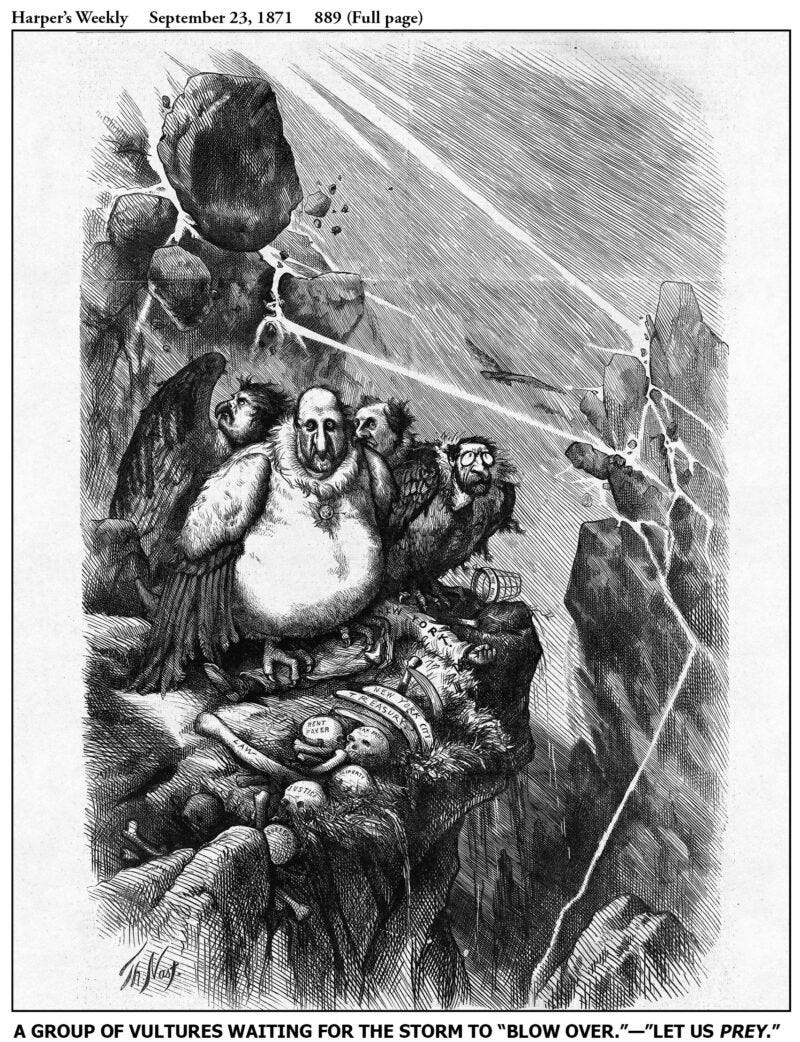
I’ll bet most fans of editorial cartoons don’t even know who Thomas Nast was. As a young cartoonist in 1990s Iran, I discovered this German-born American genius and found myself captivated. If the British can proudly point to Hogarth and the French celebrate Daumier as foundational figures in the history of political cartooning, then Americans should remember that one man—Thomas Nast—stood through the Civil War and Reconstruction, fighting for American values and educating the public through his art.
The word “nasty” may go back to the 14th century, but many believe Nast gave it fresh meaning. His cartoons hit hard. His targets felt the sting, and the public understood exactly who the villain was.
In the early nineties, I spent countless hours digging through foreign publications, hunting for lessons and inspiration. I translated articles, wrote essays, and hoped that my fellow Iranian artists would catch the spark I felt. I wanted them to see the magic tucked between the lines, the way Western cartoonists held power to account with nothing but ink and nerve.
But in Iran, we could not touch certain subjects. Drawing clerics or mocking religious authorities was off limits. Even when I used a crocodile to repeat the exact words of an Ayatollah, I ended up in Evin Prison for six days. That same prison, infamous for torture and executions, was recently the site of a deadly fire during a riot. The repression remains.
Thomas Nast, in his time, was one of a kind. His work at Harper’s Weekly did more than entertain. It demolished reputations. Boss Tweed, the corrupt political kingpin of Tammany Hall, once begged, “Stop them damn pictures,” because Nast's cartoons had done what words alone could not. Though Nast had little formal education, he surrounded himself with informed voices, sharpened his arguments, and delivered them with devastating precision.
When he supported someone, it meant something. Abraham Lincoln reportedly said that Nast’s support was worth more than a hundred newspapers. Some accounts even quote Lincoln calling Nast the Union’s best recruiting sergeant. His pencil, Lincoln believed, was more powerful than a thousand bayonets.
Nast used that pencil to support the Union and to help re-elect Lincoln in 1864. He was effective, and the historical record proves it. His cartoons of Boss Tweed didn’t just influence opinion. They defined it. And in one of history’s strangest ironies, when Tweed fled the United States, he was arrested in Spain after local police recognized him from Nast’s cartoons. That image of “Mr. Money Bags” had traveled farther and hit harder than any warrant could.
In 2001, when I traveled to North America to receive an award, I attended the joint convention of American and Canadian editorial cartoonists in Toronto. I was amazed to find over a hundred full-time cartoonists in one place. Many of them were my heroes. I soaked it all in and brought back a suitcase filled with books that would later become the foundation of my teaching at the Iran House of Cartoon. I also wrote essays for two national newspapers based on what I had learned.
At the airport in Tehran, customs officers combed through those books, hoping to find something incriminating. Thankfully, they missed the Simpsons videotapes I had tucked between them. Still, after that trip, I was summoned to court a few times. The judge in particular, known among journalists as the "Butcher of the Press," had read my essays. He had seen what I wrote about Nast. I had argued that Nast gave a voice to the voiceless through a medium everyone could understand. To them, that was dangerously close to heresy.
Now, more than two decades later, I look at the editorial cartooning landscape in North America and feel a different kind of sadness. The number of full-time staff cartoonists has dwindled. It now seems easier to become a senator than to land a cartoonist's job at a major newspaper.
I’ve also come to understand that Nast, like many historical figures, was complicated. He stood for abolition and civil rights, but he also published racist depictions of Black Americans, Irish Catholics, and Chinese immigrants. Learning that was deeply disappointing. Still, it taught me something important. There are no perfect heroes. Every artist, even the boldest, carries their contradictions.
As for today’s editors, I am not sure how many still have the courage to stand behind bold political art. If even a handful showed the same resolve as those who once published Nast’s fiercest work, maybe the cartoonist’s pen would still be shaping public understanding the way it once did.
I do not believe cartooning is dying, but it is growing weaker. Cartoonists around the world are more cautious now. Fear hangs over the page—fear of censorship, lawsuits, or far worse. Just this week, an old friend of mine in Iran drew a cartoon of the president riding a jackass, both of them looking in opposite directions. It was clever, simple, and clear. Now, some are calling for him to be punished, even ruined.
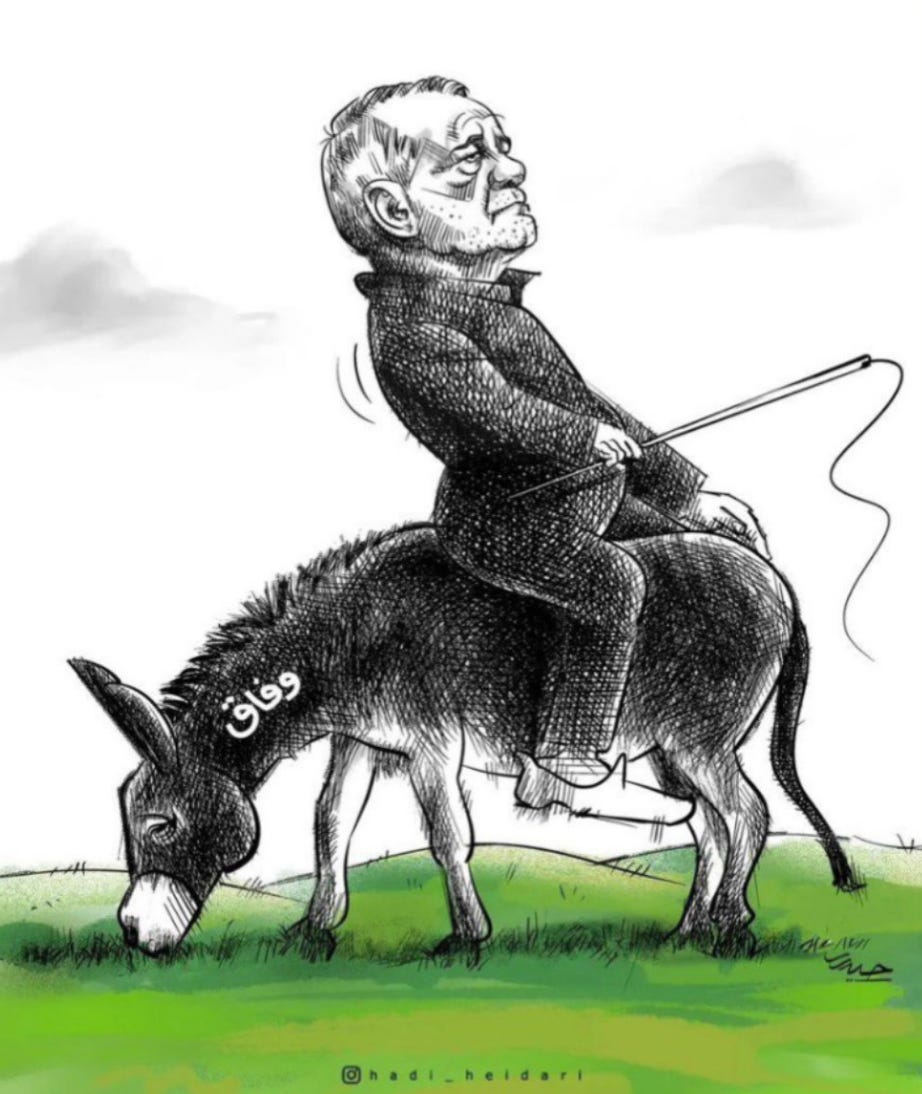
Cartooning has always been a risky art. It is one of the purest forms of truth-telling. It cuts through noise with ink and wit. Thomas Nast did it in the 1800s. Some of us have tried to do it in the shadows of theocratic power. The difference today is not the strength of the cartoon itself, but whether institutions still have the courage to stand behind it. If we want future generations to think critically, laugh at the powerful, and see through lies, we must defend the role of the cartoonist. Not just as an entertainer or a commentator, but as an essential irritant in any society that hopes to remain free. The pen is still sharp. The question is whether we are still brave enough to use it.